
Tools
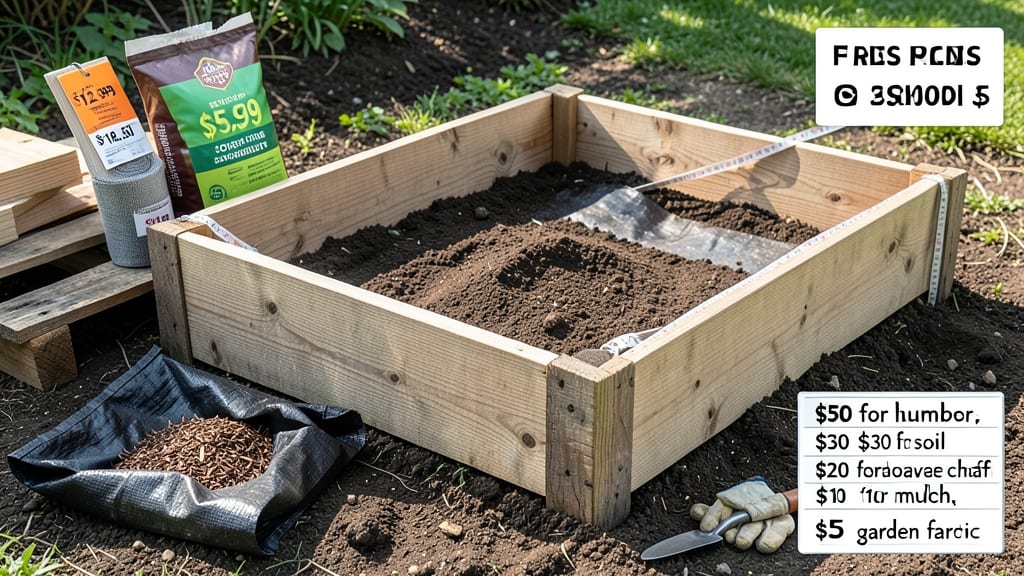
The cost of building a garden bed depends heavily on size, materials, and location, with prices starting as low as $50 for a basic 4'x8' DIY raised bed to over $1,500 for custom in-ground designs featuring premium soil and professional landscaping. Don't forget to budget for ongoing expenses like irrigation systems, mulch, and seasonal upkeep, which can easily add 30-50% to your initial investment.
Understanding these costs helps you plan better. A 4'x8' cedar raised bed might cost $150-$300 to build yourself, but that same size in composite lumber jumps to $400-$600 due to material costs.
Location plays a huge role too—urban areas with higher labor rates can make professional installation 2-3x more expensive than rural settings. I always recommend checking local lumber yards for scrap wood or repurposed materials to cut costs without sacrificing quality. 💛
What surprises most people are the hidden expenses. Drainage solutions alone can add $50-$150 to a project, while premium organic soil blends might cost $10-$20 per cubic foot compared to $5-$10 for basic topsoil.
Over time, maintenance like fertilizers, pest control, and occasional repairs can accumulate to match or exceed your initial investment. That's why I suggest starting with a smaller bed—you can always expand later once you understand the true cost of ownership.
💡 In This Article
- Key Factors That Influence Garden Bed Pricing
- DIY vs Professional Garden Bed Cost Comparison
Key factors that influence garden bed pricing
Material selection is the single biggest cost driver in garden bed construction. Cedar lumber, a popular choice for raised beds, costs $3-$8 per board foot due to its natural rot resistance and aromatic qualities.
In contrast, pressure-treated pine—cheaper at $2-$4 per board foot—requires sealing to prevent chemical leaching into your soil. For a 4'x8' bed, this translates to a $150-$300 difference between cedar and pine frames.
Composite lumber offers longevity (20+ years) but jumps the price to $6-$12 per board foot, making it a premium option for high-traffic areas.
Bed dimensions directly impact material quantities and soil volume. A standard 4'x8' raised bed requires about 16 cubic feet of soil (4" depth), while a 6'x12' bed needs 48 cubic feet. Premium organic soil blends cost $10-$20 per cubic foot, compared to $5-$10 for basic topsoil.
The math gets interesting when you consider that a 6'x12' bed with organic soil could cost $500-$1,000 just for fill alone. Regional soil quality also matters—urban areas often require imported topsoil, adding $20-$50 per yard in delivery fees.
Labor rates create dramatic price swings between regions. In high-cost cities like New York, professional installation can run $50-$100 per hour, while rural areas average $25-$40 per hour. A custom in-ground bed with irrigation and landscaping might cost $1,500-$3,000 in urban settings versus $800-$1,500 in suburban areas.
What's surprising is how quickly these costs add up with optional features—drip irrigation systems alone can cost $100-$300 installed, while decorative stone borders add $50-$200 depending on material choices.
Hidden expenses often catch gardeners off guard. Drainage solutions like gravel layers or French drains add $50-$150 to projects, while fabric liners (to prevent soil erosion) cost $1-$3 per square foot. Mulch alone can cost $50-$150 per year for a medium-sized bed, and seasonal fertilizers add $20-$50 annually.
The cumulative effect is that a $500 raised bed might actually cost $1,000-$1,500 over three years when factoring in all these ongoing costs. This is why I recommend starting with a 4'x4' bed ($100-$200 initial cost) to test your gardening skills before scaling up.
Location-specific factors further complicate pricing. Coastal areas may require salt-resistant materials adding $10-$30 per linear foot, while northern climates need extra insulation (like straw bales) costing $20-$50 per bed**. Permits for in-ground modifications can run $100-$500 depending on local regulations.
The most cost-effective approach I've found is to visit local recycling centers—many offer free or discounted wood pallets that can be repurposed into sturdy raised beds with minimal finishing work.
Understanding these variables helps you make smarter purchasing decisions. For example, if you're on a tight budget, a 4'x4' cedar bed with basic topsoil might be your best starting point at $150-$250.
But if you're planning a large vegetable garden, investing in composite lumber and organic soil upfront could save you money in the long run by reducing maintenance needs.
The key is balancing your immediate budget with your long-term gardening goals—what works for a container gardener won't necessarily suit someone planning a full vegetable plot.